
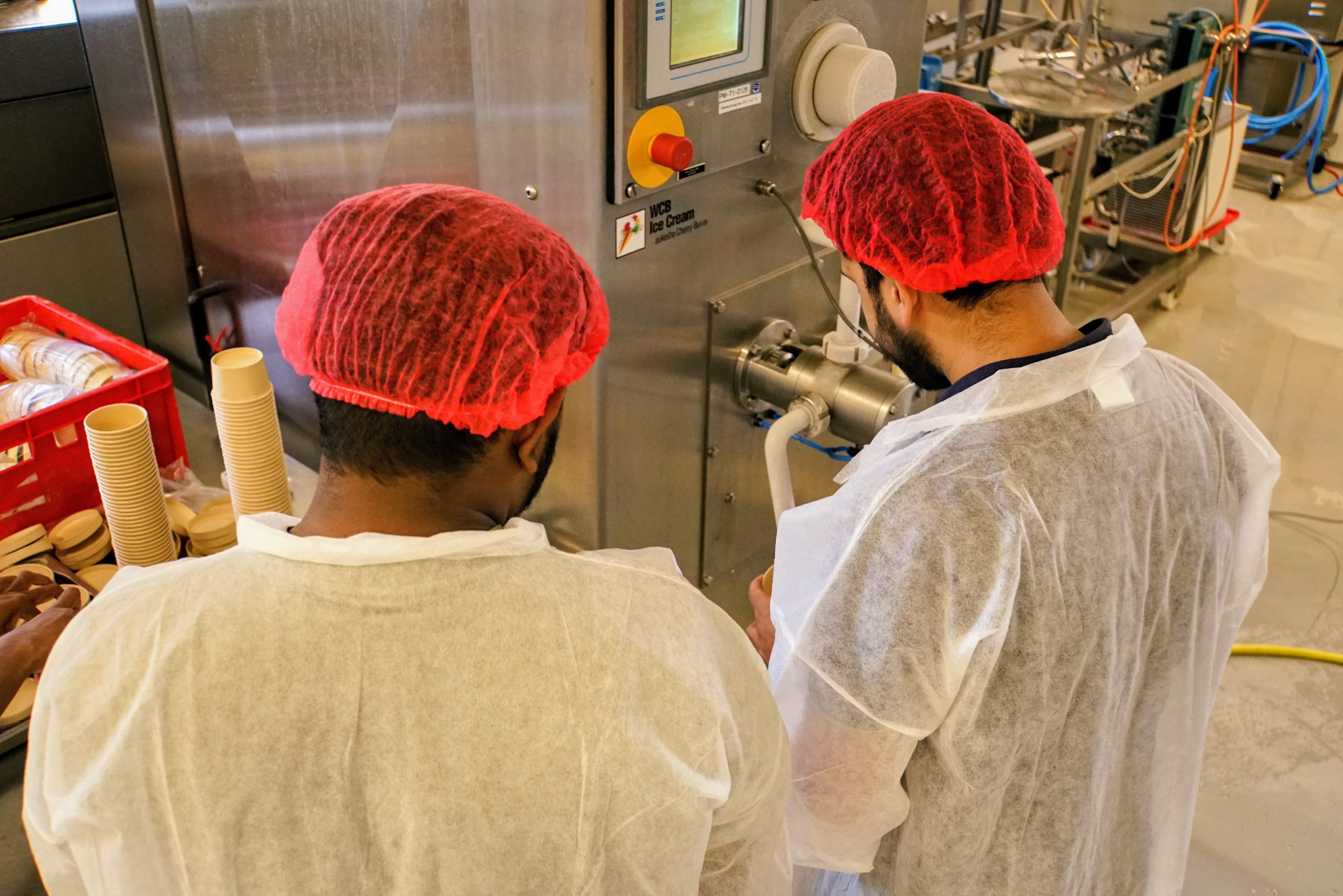
The European Union produces 3.3 billion liters of ice cream every year, worth close to €7.6 billion. In Germany alone, each person consumes around 8 liters annually and 81% of that comes from industrial production lines, not artisan scoops. Behind every litre is a formulation, a process, and a set of engineering decisions that most people never think about while eating it.
FPPE students thought about very little else during the ice cream practical this August.
The task was straightforward on paper: calculate and produce two vanilla ice cream formulations, one using coconut oil, one using olive oil, following the same industrial process used in real production. Before even entering the lab, students had to work out the complete recipe mathematics: total fat , milk solids non-fat levels, relative sweetness, lactose limits, total solids. Two formulations, each meeting the same strict set of targets, with only the fat source changing. The calculation had to be done right before the practical day. Arriving with the wrong numbers meant starting the process with the wrong mix.
In the lab, the process followed industrial logic from start to finish from dispersing over pasteurization to freezing.
The sensory analysis is where the two formulations had to answer for themselves. Students evaluated both samples across six attributes like firmness, sweetness, melting rate, smoothness, fat film adhesiveness, and cooling sensation in the mouth and then tackled the question the whole practical had been building toward: is olive oil a reasonable ingredient in ice cream, from both a sensory and nutritional standpoint?
It is the kind of question that has no obvious answer before you have actually made the product, frozen it, and tasted it. Which is precisely why you have to make it first.
👉 www.instagram.com/master_foodscience/


