
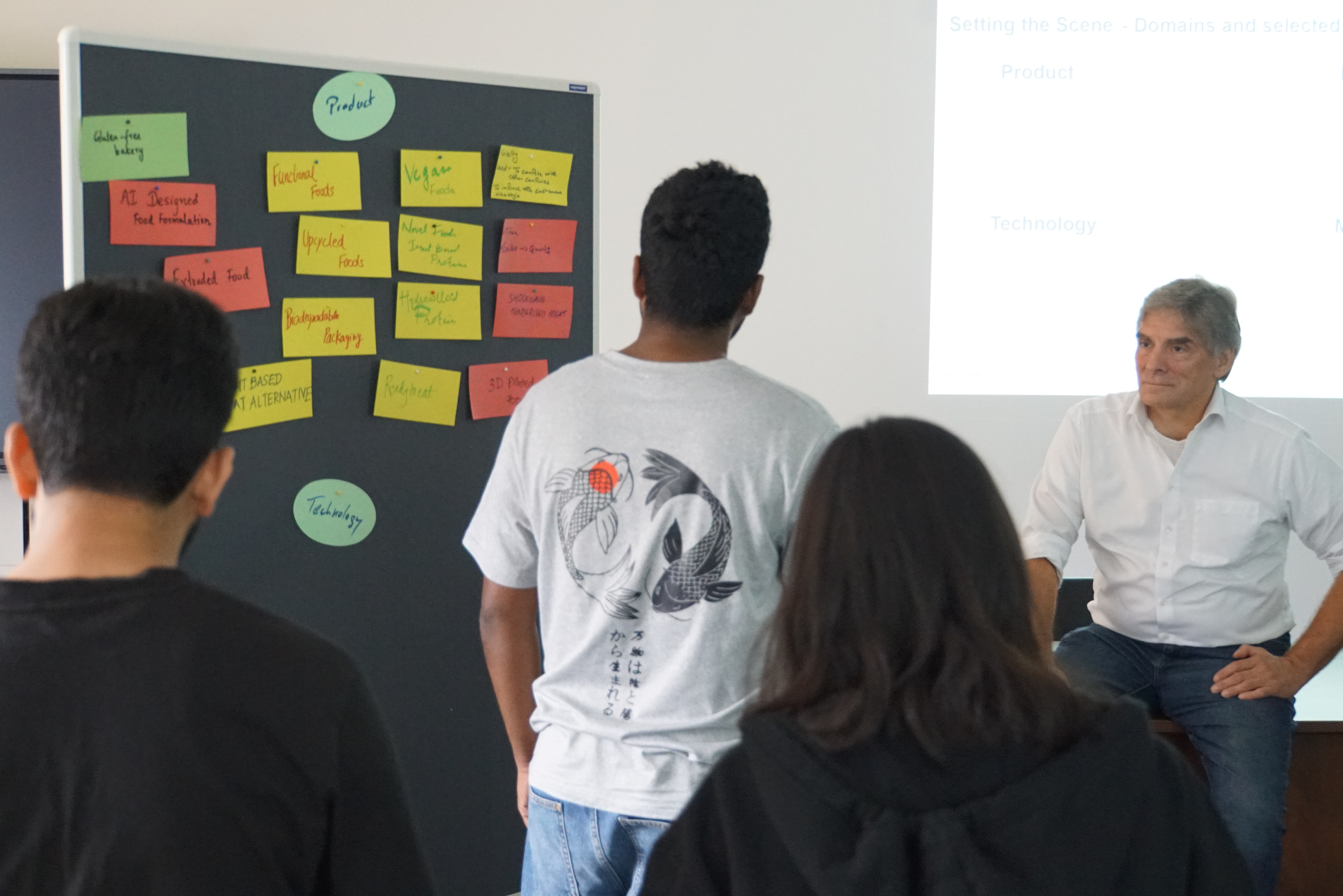
That question opened the workshop, and it was not a warm-up. It was the whole point.
Led by Prof. Thorsten Blecker (TUHH) and welcomed by Prof. Kemal Aganovic, the two-day workshop on Innovation, Knowledge and Technology Transfer pushed students to look at the food industry from the outside in. Before anyone touched a food-related problem, the first day was spent entirely elsewhere, automotive factories, retail logistics, digital supply chains. Not as a detour, but as a strategy. The best ideas in food often come from industries that solved similar problems years ago.
Day two brought it back to food and made it personal. Students were handed a real, unresolved challenge: how do you turn food side streams, the fruit peels, spent grains, and vegetable trimmings that most factories simply discard, into something safe, sellable, and worth buying? Working in teams through a full design thinking sprint, they challenged their own assumptions, generated ideas, and pitched it.
What made it land was the format. Every student had the chance to present a business idea rooted in their own background, which was then examined, challenged, and reshaped by the group and the mentor not to tear the idea down, but to stress-test it against the frameworks and assumptions that industry actually uses. Several students later said it was one of the best workshops they had attended. More than a few wished it had gone on for longer.
What stayed with students was not just the content, it was the approach. Two days of being asked to think differently, borrow from unexpected places, and sit with problems that do not have clean answers. Exactly the kind of practice the food industry can profit from.
Big thank you to Prof. Blecker for keeping the energy up and the thinking honest across both days.
👉 www.instagram.com/master_foodscience/


